
When I hear complaints about the severity of a cross country course note should be taken of what our predecessors considered `proper’ cross country. A 1951-52 Liverpool Pembroke fixture card gives some idea of what the season looked like.
The Calendar
- Throughout the country the season traditionally began with a massive social run or Monster Meet. The local harriers would meet collectively and jog gently over 7 or so miles. There were even stewards to haul back any show-offs who wanted to blast away. In the local instance, though, everybody would line up for a final one-mile dash. Winning this was considered quite prestigious.
- The competitive season started and finished with road relays, the Lancashire 8 stage invariably along the prom at Southport and the 6 Stage Liverpool and District mostly at Sefton Park.
- The championships were pretty much the same as now comencing with the county in the New Year. However, everybody was then in Lancashire which included what is in now Merseyside, Greater Manchester and Lancashire, also a chunk of Cumbria! Naturally Lancashire was incredibly strong and tended to dominate the Inter-counties. Gaining a Lancashire vest was an outstanding achievement.
- The Liverpool and District Championships, with its long history, also turned up in late January followed by a West Lancashire Championships in February. All of these were fiercely fought and there was still, of course, the Northern and National to come.
- In between there was a variety of fixtures, mostly inter-club with oddities like a Cyclists v Harriers match over the country. This was more often than not won by the cyclists who when not pedalling would pick up their bikes and run. It was always embarrassing to be overtaken by an energetic cyclist running and carrying a bike!
- The aim was to look for competition almost every week and build gradually towards championships with a weekly race or fast work out. It still makes sense to me but what do I know?
- There were no leagues locally until the mid-50`s when this added another dimension.
- There were some races for women but these were times when it was considered too stressful for the female form. Even 800m on the track was frowned on.
Venues
The local venues included
- Court Hey: Pembroke was based for about 20 years at Court Hey, Broadgreen and had comfortable changing facilities at the back of what was a grand house. The immediate park led on to Bowring Park and after a circuit of that into fields at the rear of the Belle Vale area. The return to HQ was often through mud and plough. The total lap was about three miles which made it pretty accurate for Youths (16-18) one lap, Juniors (18-21) 2 laps and Seniors (21+) 3 laps.
- Liverpool Harriers had a wooden hut buried in Woolton Woods, Sefton operated out of the Village Hall in West Derby and Boundary Harriers (now Skem Boundary) had the stables at the back of the Old Roan in Aintree. Perhaps the most exotic location was Sutton Harriers who used the changing facilities and blissful showers afterwards of the colliery!
Courses
- The `harrier’ tradition sprang from hunting across open country and numerous obstacles to negotiate. Initial races were `paper-chases’ following similar lines taken by the fox. These tough many-faceted course lingered into the 60`s and 70`s. eventually giving way largely to risk free parks and boring grassland. Another victory for Health and Safety?
- A `course’ 60 years ago could include grass, dirt tracks (even tarmac in places), canal paths, footbridges, tunnels, rivers, woods and plough. I remember being highly praised once, during my time in the Midlands, for helping to plot a lap that included 200 yards of plough, a brook you had to wade through, two stiles to climb over, part of an old railway track and a series of 5 dried up-and-down energy-sapping features that had once been the fish ponds of a medieval monastery!
- The sheer variety of courses led to `specialisms’ eg those usually of small small and light stature, who would wait to strike when the field hit the plough and the bigger guys were wallowing in the mud. There were even the cunning who having carefully reconnoitred the course had found a hole in the fence some 50 yards adrift of a stile and reckoned that the extra distance was not just more advantageous and safe, and certainly better than an elbow in the gob in an impatient queue.
- The often rapid change of features and challenges meant runners had to be continually alert and looking ahead not simply switching on the metronome and blindly following a leader. A thinking man`s sport?
Postscript
Old style cross country has not yet died the death. Reports from the last Mid-Lancs fixture at Cuerden Park suggest there are still course planners with a sense of humour and history. Nobody died I understand and most seem to have recovered from the experience.
But for those who really want to revel in yesteryear there is always the Parbold Hill Race in February. Stunningly organised by our Skem Boundary colleagues it captures everything that is so much fun and fulfilling about amateur sport. Right down to the tin baths at the finish it is a delight. If you`ve not done the Parbold hang your head in shame but you still have time to sample it! But don`t leave it too late…for some perfectly understandable reason it is hugely popular and oversubscribed. There`s hope for the sport yet.
Charles Gains
Memories… of the way we were
When I hear complaints about the severity of a cross country course note should be taken of what our predecessors considered `proper’ cross country. A 1951-52 Liverpool Pembroke fixture card gives some idea of what the season looked like.
The Calendar
- Throughout the country the season traditionally began with a massive social run or Monster Meet. The local harriers would meet collectively and jog gently over 7 or so miles. There were even stewards to haul back any show-offs who wanted to blast away. In the local instance, though, everybody would line up for a final one-mile dash. Winning this was considered quite prestigious.
- The competitive season started and finished with road relays, the Lancashire 8 stage invariably along the prom at Southport and the 6 Stage Liverpool and District mostly at Sefton Park.
- The championships were pretty much the same as now comencing with the county in the New Year. However, everybody was then in Lancashire which included what is in now Merseyside, Greater Manchester and Lancashire, also a chunk of Cumbria! Naturally Lancashire was incredibly strong and tended to dominate the Inter-counties. Gaining a Lancashire vest was an outstanding achievement.
- The Liverpool and District Championships, with its long history, also turned up in late January followed by a West Lancashire Championships in February. All of these were fiercely fought and there was still, of course, the Northern and National to come.
- In between there was a variety of fixtures, mostly inter-club with oddities like a Cyclists v Harriers match over the country. This was more often than not won by the cyclists who when not pedalling would pick up their bikes and run. It was always embarrassing to be overtaken by an energetic cyclist running and carrying a bike!
- The aim was to look for competition almost every week and build gradually towards championships with a weekly race or fast work out. It still makes sense to me but what do I know?
- There were no leagues locally until the mid-50`s when this added another dimension.
- There were some races for women but these were times when it was considered too stressful for the female form. Even 800m on the track was frowned on.
Venues
The local venues included
- Court Hey: Pembroke was based for about 20 years at Court Hey, Broadgreen and had comfortable changing facilities at the back of what was a grand house. The immediate park led on to Bowring Park and after a circuit of that into fields at the rear of the Belle Vale area. The return to HQ was often through mud and plough. The total lap was about three miles which made it pretty accurate for Youths (16-18) one lap, Juniors (18-21) 2 laps and Seniors (21+) 3 laps.
- Liverpool Harriers had a wooden hut buried in Woolton Woods, Sefton operated out of the Village Hall in West Derby and Boundary Harriers (now Skem Boundary) had the stables at the back of the Old Roan in Aintree. Perhaps the most exotic location was Sutton Harriers who used the changing facilities and blissful showers afterwards of the colliery!
Courses
- The `harrier’ tradition sprang from hunting across open country and numerous obstacles to negotiate. Initial races were `paper-chases’ following similar lines taken by the fox. These tough many-faceted course lingered into the 60`s and 70`s. eventually giving way largely to risk free parks and boring grassland. Another victory for Health and Safety?
- A `course’ 60 years ago could include grass, dirt tracks (even tarmac in places), canal paths, footbridges, tunnels, rivers, woods and plough. I remember being highly praised once, during my time in the Midlands, for helping to plot a lap that included 200 yards of plough, a brook you had to wade through, two stiles to climb over, part of an old railway track and a series of 5 dried up-and-down energy-sapping features that had once been the fish ponds of a medieval monastery!
- The sheer variety of courses led to `specialisms’ eg those usually of small small and light stature, who would wait to strike when the field hit the plough and the bigger guys were wallowing in the mud. There were even the cunning who having carefully reconnoitred the course had found a hole in the fence some 50 yards adrift of a stile and reckoned that the extra distance was not just more advantageous and safe, and certainly better than an elbow in the gob in an impatient queue.
- The often rapid change of features and challenges meant runners had to be continually alert and looking ahead not simply switching on the metronome and blindly following a leader. A thinking man`s sport?
Postscript
Old style cross country has not yet died the death. Reports from the last Mid-Lancs fixture at Cuerden Park suggest there are still course planners with a sense of humour and history. Nobody died I understand and most seem to have recovered from the experience.
But for those who really want to revel in yesteryear there is always the Parbold Hill Race in February. Stunningly organised by our Skem Boundary colleagues it captures everything that is so much fun and fulfilling about amateur sport. Right down to the tin baths at the finish it is a delight. If you`ve not done the Parbold hang your head in shame but you still have time to sample it! But don`t leave it too late…for some perfectly understandable reason it is hugely popular and oversubscribed. There`s hope for the sport yet.
Charles Gains
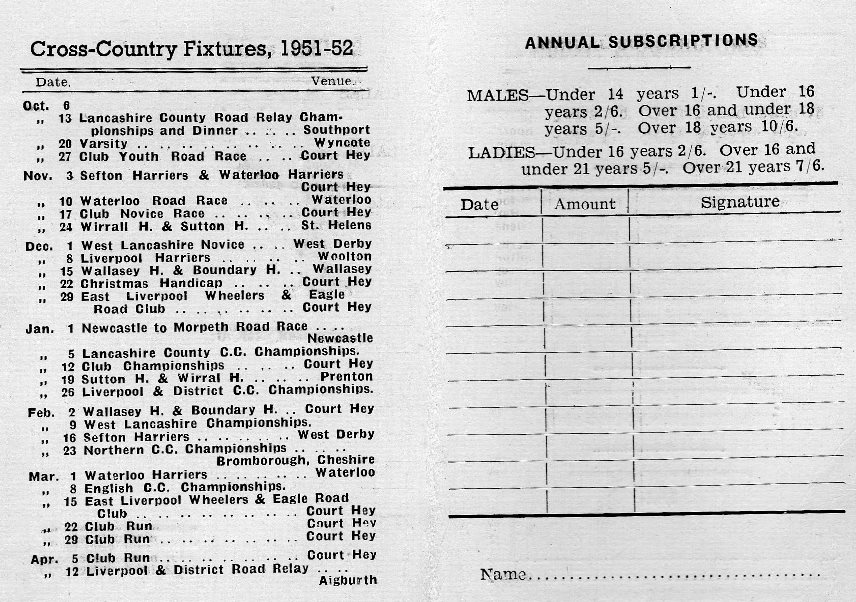
Pembroke Fixture List 1951



Comments are closed.